Independence documentary ‘The Eyes of Ghana’ screens in Accra
The story of Ghana’s independence, its first president and the continent’s struggle for liberation unfolded before the lens of one man whose work was almost erased from history. Decades later, veteran Ghanaian cinematographer Rev. Chris Tsui Hesse is determined to ensure that those images are not lost to future generations.
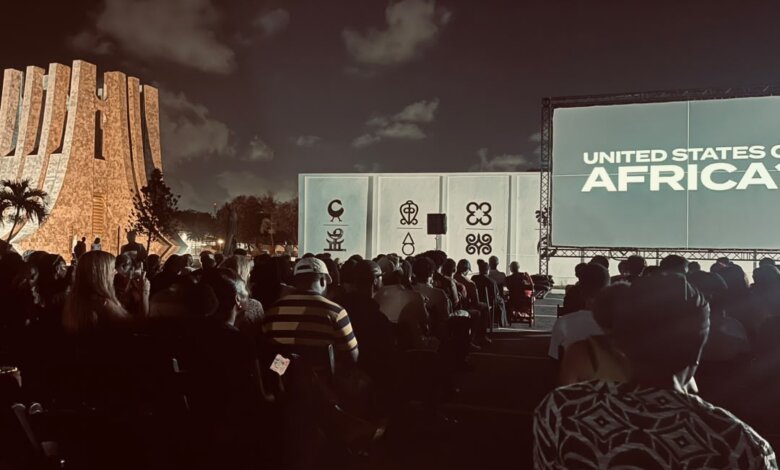
That story took centre stage on Saturday, October 31, when The Eyes of Ghana, a feature-length documentary chronicling Hesse’s life and remarkable career as the personal cameraman of Ghana’s first president, Dr. Kwame Nkrumah, was screened at the Kwame Nkrumah Memorial Park in Accra.
Born on August 29, 1932, Hesse developed a love for cinema at an early age, eventually pursuing a career in cinematography. His professional journey took a defining turn when he received a call assigning him to work as Nkrumah’s personal cameraman, placing him in the company of one of Africa’s most influential political figures.
He recalled that on several occasions, he was the only Black cameraman in the room, an experience that offered him a unique position from which to document Ghana’s political transformation and the wider African independence movement.
His relationship with Nkrumah also extended beyond the usual working relationship between a president and his cameraman. Hesse recalled how the former president sometimes used his walking stick to communicate with him, creating a distinctive form of understanding between the two.
One of the most memorable exchanges between them came during the final days before the February 24, 1966 coup that overthrew Nkrumah. Rev. Chris Hesse recounted how Nkrumah asked him whether he understood the meaning of a coup before encouraging him not to be afraid and to continue filming.
His message to the young cinematographer was simple: “Don’t be afraid. Keep on filming.” That instruction would become particularly significant following the overthrow of the government.
With Nkrumah branded a dictator by his opponents, the coup makers ordered the destruction of films and documents associated with his administration. However, Hesse’s negatives had been safely preserved in London, protecting an extraordinary visual record of Ghana’s political history from destruction.
The archive, comprising more than 1,000 films, captures important moments surrounding Ghana’s independence, Nkrumah’s leadership and his ambition for a united Africa governed by Africans.
For Nkrumah, filmmaking was beyond an exercise in documenting events. It was a tool for telling African stories from the perspective of the people who experienced colonialism and fought for independence. He wanted cinema to help market Ghana internationally, project African identity and advance the vision of continental unity.
However, as Nkrumah’s political influence grew, so did opposition to his leadership. His supporters and critics have continued to debate his legacy, making the surviving footage an important resource for understanding the different dimensions of his presidency.
The documentary has also attracted considerable international attention. Following its premiere at the 2025 Toronto International Film Festival, where it opened the documentary programme, The Eyes of Ghana went on to feature at several international film events.
In the United States, it screened at AFI Silver Theatre in March 2026 and featured in the New York African Film Festival from May 6 to 12. It subsequently received a special one-night theatrical release across participating cinemas in the United States and Canada on October 28, 2026, with major exhibitors including AMC, Regal and Cinemark.
The North American theatrical release brought additional international attention to Hesse’s story, with popular American streamer IShowSpeed joining the film as a producer. Former US President Barack Obama and former First Lady Michelle Obama also served as executive producers through their production company, Higher Ground Productions.
Directed by two-time Academy Award-winning filmmaker Ben Proudfoot, the documentary follows Hesse’s efforts to rescue, restore and repatriate the historic collection before his deteriorating eyesight, caused by glaucoma, makes the task increasingly difficult. It also highlights the importance of passing this cinematic heritage to younger generations.
Asked whether Nkrumah was a good or bad leader, Hesse’s position was that he had filmed the man’s life and left it to people to watch the footage and make their own judgments.
It is a fitting reflection of the documentary’s central purpose: allowing history to be examined through the images of someone who witnessed it firsthand.
With its screening at the very memorial park dedicated to Nkrumah’s memory, The Eyes of Ghana offered audiences an opportunity to revisit a defining chapter of Ghanaian history through the eyes of the man who recorded it.
Source: TheAfricanDream.net