Ghana grants citizenship to 150 Diasporans in Accra ceremony
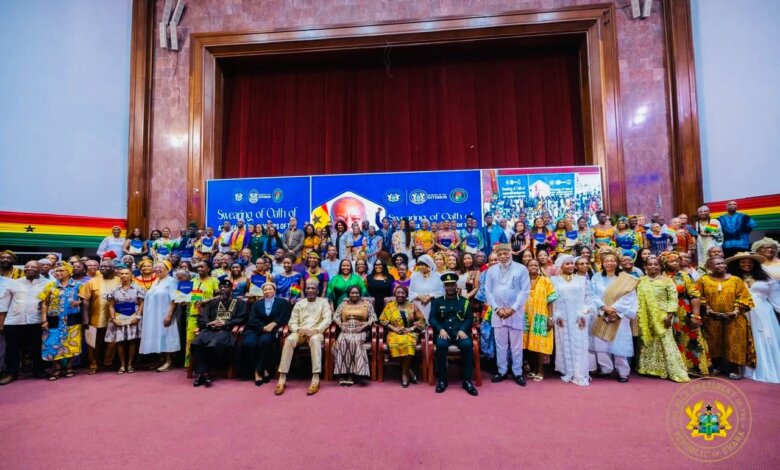
More than 150 African diaspora members were granted Ghanaian citizenship on Monday March 9, 2026 in a ceremony held at the Accra International Conference Centre (AICC), the latest wave of a growing movement reconnecting descendants of Africans abroad with the continent.
The Diaspora Affairs Office at the Presidency, which coordinated the process, received around 3,000 applications before approving the final 150 following a thorough review and vetting exercise. Vice President Jane Naana Opoku-Agyemang, government officials, diplomatic corps members and diaspora community representatives attended the event.
Circuit Court Judge Annette Sophia Essel administered the Oath of Allegiance, formally binding the new citizens to the Republic of Ghana. Diaspora Affairs director Kofi Okyere-Darko called the ceremony a historic milestone, saying it reflected a growing sense of unity and shared purpose among Black people around the world.
The programme, he said, was as much about charting a path forward for Africa and its diaspora as it was about acknowledging the present moment. Interior Minister Muntaka Mubarak Mohammed used his address to walk attendees through the steps applicants were required to complete before gaining approval.
Ghana, he emphasised, does not take citizenship lightly and the rigorous standards applied to all applicants reflect how seriously the country regards that status. After taking oaths of allegiance and receiving their certificates, the new citizens were addressed by Ghana’s Vice President Jane Naana Opoku-Agyemang and Interior Minister Muntaka Mubarak Mohammed.
She emphasized the diaspora’s importance to Africa’s development and reaffirming the government’s view of Africans abroad as the continent’s “sixth region.” Ghana, she said, remains open to all people of African heritage looking to reconnect with their roots.
“Distance may separate our people, but it does not erase identity,” Opoku-Agyemang told the gathering. “Ghana continues to be a home for the global African family.“
Clutching her citizenship certificate to her chest and fighting back tears, Patrice Ann Robertson had finally made it official. Nearly a decade after leaving the United States to build a new life in Ghana’s southeastern Volta region, the Ghanaian-American is now a citizen of the country she calls home.
“This is home,” Robertson told AFP at the ceremony held in the oceanside capital Accra. In nine years since her relocation, she has returned to her birthplace in the United States just once.
Robertson was among 150 diaspora members to receive Ghanaian citizenship at the ceremony; the latest group in an expanding national initiative that has now seen more than 1,000 Africans from abroad obtain citizenship in recent years. Many are Black Americans drawn by a combination of historical, cultural and deeply personal motivations.
For many of those gathered, the moment represented the end of a long search for belonging. Nataki Kambon, who received her Ghanaian citizenship in 2019 and returned to witness Monday’s ceremony, said the process allowed her to reclaim a part of her identity that had long felt out of reach.
“I grew up in a household where we always knew we were African,” she said. “But there’s still a disconnect because of how Africa is portrayed in the United States,” she said.
For some, the path to citizenship began with a single visit. Robert and Serita Faison, a couple from the United States, said they fell in love with Ghana during a trip one year ago and knew almost immediately they wanted to put down roots.
“It feels like we’ve come full circle,” Robert Faison said. “We learned so much about the history here and how it connects to our ancestors. It just seemed right to come back.”
The process required substantial documentation and formal approvals, but Faison said it was “certainly doable.” Others said the emotional weight of the decision made any bureaucratic hurdles worthwhile.
Kevin Harris, who grew up in Washington, D.C., cited safety and quality-of-life concerns in the United States as key factors in his decision to relocate. He described the moment he became a Ghanaian citizen as “earth-shaking.“
“I grew up going out to play outside. I see that here,” said Harris, holding his certificate and a small Ghana flag. “I want my grandchildren to be able to go out in the neighbourhood and play. In America, you always feel like you have to watch your children.“
Ghana has actively positioned itself as a gateway for diaspora return since launching its landmark “Year of Return” initiative in 2019, which marked 400 years since enslaved Africans were first transported to North America. The programme encourages people of African descent to visit, invest and forge deeper ties with the continent.
The government views the diaspora not only as part of a shared historical family, but as a vital development partner. Interior Minister Mohammed said the event reflected growing international recognition of the injustices of the transatlantic slave trade and the urgency of rebuilding broken connections.
For Ghana, welcoming diaspora citizens also means gaining access to expertise, investment and global networks; resources the country hopes will help shape its future.
Written by Kweku Sampson