
The ghost of laptops past and the ten-million cedi miracle
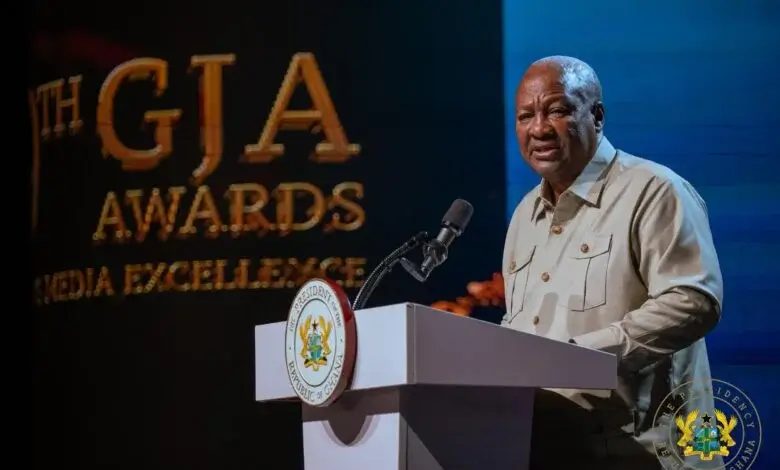
If there is one thing Ghanaian politics teaches us, it is that history does not merely repeat itself; it simply returns with an extra zero attached to the invoice. Over the weekend at the grand celebration of the 30th Ghana Journalists Association (GJA) Media Awards, President John Dramani Mahama took to the podium to announce a shiny new GH¢10 million seed fund allocated in 2027 Budget. The crowd clapped, the tea was sipped, and a collective wave of selective amnesia washed over the room.
To the uninitiated, this was a magnificent gesture toward upgrading investigative journalism, digital literacy, and the elusive concept of journalist welfare. But for those of us with slightly longer memories, a familiar, phantom itch began to prickle behind the ears. It was the unmistakable, lingering specter of the great 2011 Media Development Fund (MDF) debacle.
To appreciate the sheer comedic genius of our current trajectory, one must take a nostalgic stroll down the potholed memory lane of 2011. Back then, the government in its infinite wisdom introduced a GH¢1 million seed fund. It was supposed to be a sacred trust managed by an autonomous entity, perhaps the National Media Commission (NMC), to elevate the fourth estate into an unassailable bastion of ethical professionalism.
Instead, the Ministry of Information looked at the money, looked at the independent bodies, and decided that true independence is best managed directly from the absolute comfort of a government office. The governance structure became an exclusive party of one, birthing a legendary template of opaque disbursements that would make standard magicians blush.
The climax of that bygone era arrived in 2013 when the then Information Minister, Mahama Ayariga, triumphantly declared to Parliament that the state had cracked the code of media development. The ultimate tool for modern journalism, he revealed, was a massive fleet of 952 laptops.
According to official state lore, these digital chariots were procured after deep, exhausting consultations with every major stakeholder group under the Ghanaian sun. The minister painted a beautiful picture of unity, where umbrella groups sat in harmony, happily orchestrating the distribution of laptops to eager scribes across the nation. It was a flawless narrative, right up until the stakeholders actually opened their mouths.
What followed was a masterclass in administrative slapstick comedy. The Ghana Independent Broadcasters Association (GIBA) immediately broke ranks, flatly denying they had ever sat in such a meeting, let alone set eyes on a single piece of government-sponsored plastic.
Meanwhile, the GJA looked around its offices, crunched the numbers, and admitted they had only managed to secure a tiny fraction—somewhere between 100 and 140 laptops out of the legendary 952.
The rest of the digital fleet seemingly vaporised into thin air, leaving behind a trail of systemic failure, an unexplained GH¢150,000 gift to a mysterious “editors forum,” and a mountain of administrative gridlock. The original mission of upgrading media capacity was soundly replaced by the urgent journalistic task of hunting for missing government property.
Fast forward to the present day, and the stakes have been gloriously quintupled. We are no longer playing around with a mere single million; we are now reactivating the dream with a cool GH¢10 million.
The President has promised that things will be different, assuring us that this iteration will be transparent and completely insulated from political interference. He has even pledged to personally walk into the boardrooms of corporate heavyweights like the Bank of Ghana and the KGL Group to convince them to top up the kitty. It is an inspiring vision of a crowd-funded media renaissance, provided we ignore the structural flaws that haven’t moved an inch since the old laptop days.
The constructive, if slightly cynical, takeaway here is that multiplying the budget by ten does not automatically multiply accountability by ten. If the new GH¢10 million fund is poured into the exact same top-down bureaucratic funnel that swallowed the 2011 fund, we are simply budgeting for a larger, more expensive sequel.
For this fund to be anything more than a ceremonial applause-generator, the state must genuinely surrender the checkbook to a truly independent oversight body. True media development cannot occur when the person funding the referee is also the captain of the team being refereed.
As the 2027 budget season approaches, journalists across Ghana are undoubtedly preparing their pens, updating their digital skills, and perhaps checking their desks to see if any laptops from 2013 finally decided to show up. We must watch this new fund with the sharp, unblinking focus that investigative journalism demands. If we do not demand strict institutional governance and absolute clarity on every single cedi, we might find ourselves at the next GJA awards celebrating a brand new mystery.
After all, if a single million cedi could cause nearly a thousand laptops to vanish, one can only imagine what kind of spectacular disappearing acts a ten-million cedi budget might perform.
Written by Emmanuel Amponsah, a former Editor of The Spectator newspaper in Ghana.