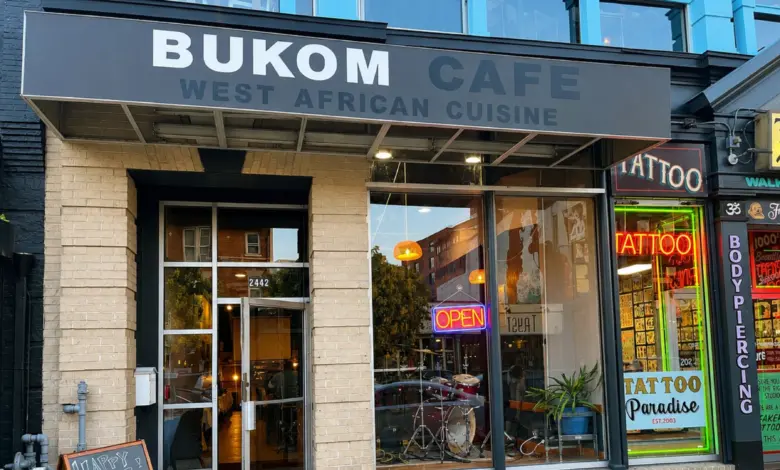
In the mid-afternoon, just before happy hour, there are moments in Adams Morgan where a visitor can hear the neighborhood come alive with the Afrobeats in Bukom Cafe. Inside the restaurant, the walls are covered with newly acquired Pan-African art created by the Cameroonian painter Shiri Achu.
The kente-patterned mosaic bartop is a part of the cafe’s original decor; it’s now on its fifth opening. Sitting at the bar, I hear this new iteration of the restaurant has patrons animated and commenting favorably. There is a new energy in this esteemed space.
When Bukom Cafe opened in 1992, it was one of the first West African restaurants in D.C., according to the original owner, Justice Matey. Over the decades, others like it have come and gone. After New York City, the Washington Metropolitan Region has the second-largest Sub-Saharan African-born immigrant population in the country, according to the U.S. Census Bureau’s American Community Survey.
Yet, nationalities with significant local populations, like Nigerians, Ghanaians and Cameroonians, are not well represented among the array of the city’s eateries. Businesses catering to residents from those countries are mostly located in the neighboring Maryland and Virginia suburbs.
Nonetheless, with an undeniably West African offering that features dishes from multiple countries, including Nigeria, Ghana and Senegal, Bukom Cafe has survived and often thrived in its present location on 18th Street for over 30 years. Its menu was first inspired by the West African heritage of Matey and his family.
It’s well-placed in Adams Morgan, given the neighborhood’s international dining scene, according to Kristen Barden, executive director of the Adams Morgan Partnership Business Improvement District.
“Adams Morgan has always been a neighborhood where global cuisine builds the community fabric,” said Barden. “When a longtime business like Bukom Cafe updates its space and brings fresh energy to its reopening, it sends a strong message that legacy businesses still have an important and evolving role to play in Adams Morgan…That balance of history and renewal is part of what keeps the neighborhood vibrant.”
Hemen “Amy” Solomon, Bukom’s current owner, took the reins in February. Solomon is a native of Ethiopia who began frequenting the cafe during the 2000s. She believes that Matey wanted it to feel like home. “That’s the reason he opened this place,” she said. “[Bukom] became a home of the diaspora, but also White, Black, Latino, Asian, [and] Hispanic” community members. All these years later, Solomon said she intends to nurture and grow that same welcoming energy.
When customers came to the reopening, they were initially concerned about the authenticity of the food because she is not West African, Solomon said. But she insists she is determined to maintain West African cuisine at the core of Bukom.
“ I always loved Nigerian culture because I’m really drawn to…the loudness, yet so much fun and so much depth to it,” she said.
Over the past couple of months, her position has involved some education. For example, she had never tried jollof rice before taking ownership of Bukom. Now it’s her favourite dish, along with goat pepper soup and pounded yam, which she has practiced making by hand.
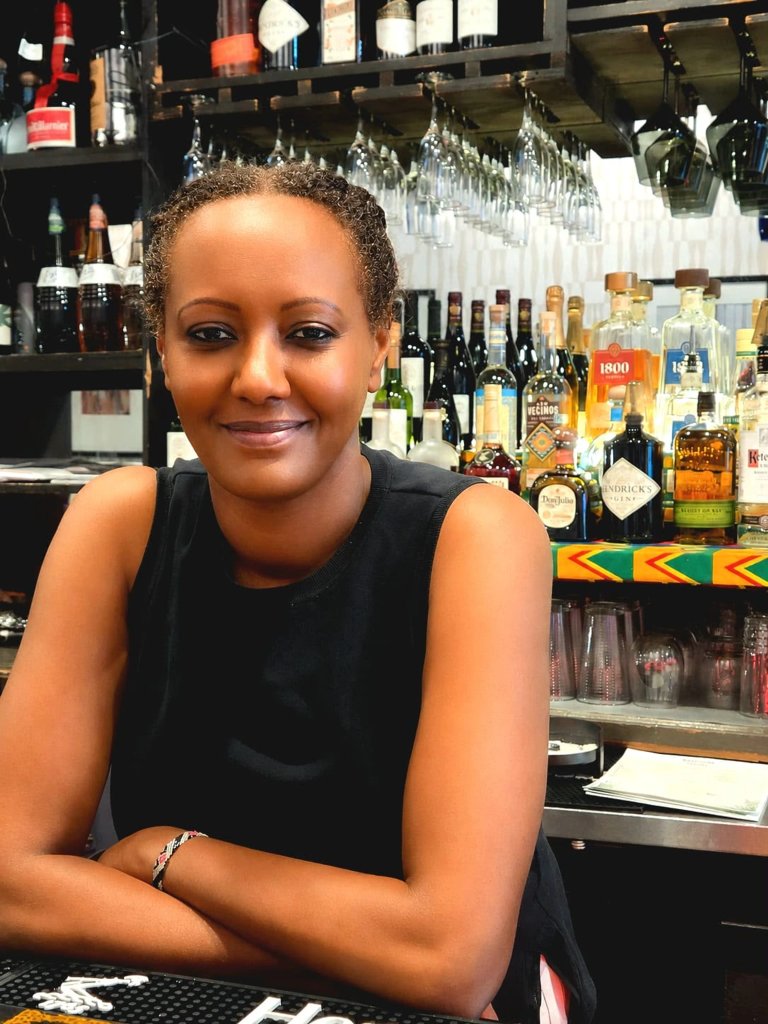
Photo: Hemen “Amy” Solomon, current owner of the African restaurant, Bukom Cafe, is a native of Ethiopia who began frequenting the space during the 2000s. / © Bukom Cafe
What makes Bukom’s lasting success even more impressive are the challenges D.C. restaurateurs already have to withstand, including the pandemic, increased wages for tipped workers through Initiative 82, federal layoffs, and the government shutdown. The restaurant and food service industry is the largest private employer in the District, and restaurateurs of all cuisines are making an effort to stay open amid the challenges.
Since last year, federal immigration enforcement has escalated and destabilized the dining industry in D.C., and Black immigrants are being disproportionately impacted. A record number of D.C. restaurants closed in 2025, the Restaurant Association of Metropolitan Washington’s spring member survey showed, and 54 percent of restaurants reported lower sales while 69 percent reported reduced profitability.
Over the years, Solomon said she has noticed the transience of other D.C. West African restaurants, such as Sumah’s West African Restaurant, Bussdown D.C., and Ghana Cafe.
There are many difficulties with running a restaurant in general, such as managing HVAC and the art of pricing alcohol to be both affordable to the customer and profitable for the restaurant owners, Solomon said. But other challenges are more unique to West African restaurants, like finding knowledgeable staff and locating specific ingredients.
Dishes such as goat pepper soup aren’t in the average chef’s repertoire and its ingredients prove harder to source, compared to the seafood and vegetable-centric dishes that make up most Ethiopian menus.
In March, when Mayor Murial Bowser took to X to tout the rise of D.C.’s Michelin star restaurants from zero in 2025 to 21 this year, her comment section received a barrage of negative remarks about her neglect of D.C.’s restaurant industry. Posters condemned the closure of “Mom and Pop shops” and the lack of affordable food options in the city.
That tension between prestige and availability is increasingly visible in the kinds of restaurants opening across the city. In recent years, a group of African restaurants has opened in the District that are noticeably upscale, some founded by a celebrity chef and reliant on an unorthodox fusion of cuisines from across the African diaspora.
Restaurants like Elmina, Marcus DC and Dōgon appeal to patrons who are unfamiliar with traditional African cuisine and are willing to pay up to $100 for a single shareable.
However, there is a stark difference between restaurants that target a wealthier clientele and those that are more accessible. That raises questions about the future of Bukom and restaurants like it.
Solomon isn’t nervous at all. She imagines West African food to be “like how Indian restaurants or Chinese restaurants are so broadly talked about” for people of all nationalities, ages, and backgrounds. “I want anyone who takes over from here to know that I worked for it. I handed it to them in a better position.”
The fate of Bukom is not Solomon’s alone, however. The continued support from D.C.’s restaurant-goers may show just how important cultural preservation is in the nation’s capital city.
Source: Afro News