Dr Wendy Okolo, Nigerian-born Aerospace Engineer at NASA
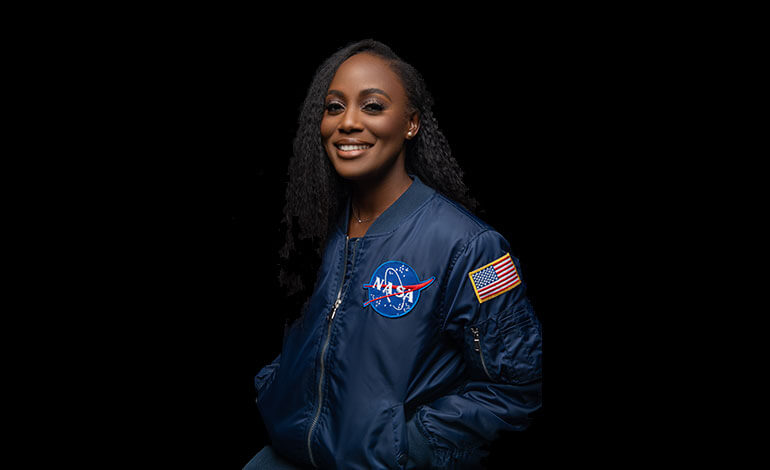
Dr Wendy Okolo, an aerospace engineer at NASA, became the first Black woman to earn a PhD in aerospace engineering at 26 from the University of Texas at Arlington in 2015, carving her name into both academic history and the future of space exploration.
Born and raised in Nigeria, Okolo’s fascination with engineering began early, fuelled by curiosity about how things worked and a desire to build solutions that could change lives. That curiosity carried her across continents, into one of America’s leading engineering institutions, and eventually into the orbit of NASA, an institution synonymous with scientific excellence and discovery.
After completing her doctorate, Okolo joined NASA’s Ames Research Center in California, where she has worked on research related to guidance, navigation and control. Her work contributes to the technologies that underpin autonomous systems, spacecraft operations and future space missions.
At NASA, she has collaborated with multidisciplinary teams of engineers and scientists, contributing to research that influences both government and commercial aerospace programs. Her expertise places her at the forefront of an industry that increasingly relies on automation, artificial intelligence and advanced control algorithms.
In addition to her technical contributions, Okolo has been recognized as an advocate for diversity and inclusion in STEM fields. She has participated in outreach initiatives, speaking engagements and mentorship programs aimed at encouraging underrepresented students to pursue careers in science and engineering.
Okolo has been vocal about the need for greater inclusion in STEM fields. She has participated in initiatives that encourage girls and students of African descent to pursue careers in science, technology, engineering and mathematics.
At just 26, Wendy became the first Black woman to earn a Ph.D. in aerospace engineering from the University of Texas at Arlington. Her graduate studies attracted prestigious recognition and funding from the U.S. Department of Defense through the National Defense Science and Engineering Graduate Fellowship, Zonta International’s Amelia Earhart Fellowship, the American Institute for Aeronautics and Astronautics, and the Texas Space Grant Consortium.
She is also a recipient of the 2019 UT Arlington Distinguished Recent Graduate Award, the 2019 Women in Aerospace Award for Initiative, Inspiration & Impact, and the 2019 Black Engineer of the Year Award for Most Promising Engineer in U.S. Government.
Her additional honors include a Resolution of Commendation from the Tarrant County Court of Texas and an excellence-in-research award from Women of Color in STEM. During her time at NASA, she received the 2020 NASA Ames Award for Researcher/Scientist and the 2019 NASA Ames Early Career Researcher Award.
Her outreach efforts emphasize that diversity in STEM is not just a social goal but a scientific necessity. Broader participation expands the talent pool and ensures that innovation reflects a wider range of perspectives and experiences.
Dr. Okolo, a recipient of the 2021 NASA Exceptional Technology Achievement Medal, has built an impressive research career spanning several leading aerospace institutions. She previously conducted aircraft formation flight research for fuel savings at the U.S. Air Force Research Laboratory (AFRL) at Wright-Patterson Air Force Base, where her work was validated through U.S. Air Force flight tests demonstrating practical fuel-efficiency gains for both existing and new aircraft.
She also contributed to Lockheed Martin’s Advanced Development Programs (Skunk Works), applying performance-optimising control techniques to the Joint Strike Fighter F-35C to enhance operational efficiency for aircraft under the U.S. Naval Air Systems Command (NAVAIR).
Earlier, as a student intern at Lockheed Martin, she worked on NASA’s Orion spacecraft, the crew exploration vehicle designed to support human missions beyond low Earth orbit. Her time as a research assistant in flight dynamics and controls further shaped and inspired her current research focus.
For young Black girls who dream of science labs, control rooms and space missions, she is proof that those dreams are not only valid but attainable. Her success spotlights the contributions of African and Black diaspora talent to global science, technology and exploration.
Written by Oral Ofori