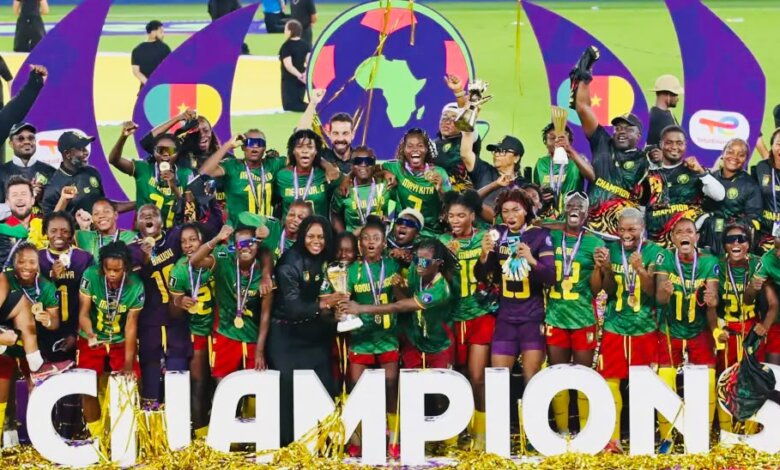
Cameroon have been crowned Women’s Africa Cup of Nations champions after beating tournament debutants Malawi 3-0 in a final that brought an extraordinary WAFCON campaign to a close in Rabat, Morocco.
Few would have predicted this final when the tournament began. Aside from hosts Morocco, the eventual last-four line-up was far from obvious and even fewer would have expected Cameroon and Malawi to be the two teams left standing at the end.
CAF’s decision to expand the competition from 12 to 16 teams has therefore proved a significant one. The wider field has given nations outside the traditional continental powerhouses an opportunity to showcase their quality and close the gap on established teams such as Nigeria and South Africa.
Malawi, ranked 153rd in the world and making their WAFCON debut, were perhaps the clearest example of that progress. The Scorchers defied expectations throughout the tournament, with sisters Tabitha and Temwa Chawinga leading their attacking charge. But Cameroon had too much for them when it mattered most.
The Indomitable Lionesses made the perfect start, breaking the deadlock in the 20th minute. Naomi Eto’s cross caused problems in the Malawi box and after Grace Mendoua’s header was tipped onto the crossbar by goalkeeper Mercy Sikelo, Marie Ngah Manga reacted quickest to score from close range.
Cameroon doubled their advantage 10 minutes later. Malawi failed to clear a corner and Eto took full advantage, turning inside the area before firing a superb first-time volley into the bottom corner.
The third came in first-half stoppage time. Sikelo ventured off her line to intercept a through ball from Genevieve Ngo Mbeleck, but Eto beat her to it and raced towards the byline before cutting the ball back for Ngah Manga to head into an empty net. The goal gave Ngah Manga her fifth of the tournament and left Malawi with a mountain to climb.
A major reason Cameroon were able to keep the Chawinga sisters quiet was the work of Monique Ngock in midfield. She repeatedly disrupted Malawi’s attempts to feed the forwards, cutting off the passing routes that had been so effective during the Scorchers’ run to the final.
Malawi briefly threatened after the break. Ngah Manga missed an opportunity to complete her hat-trick when she rounded Sikelo but fired wide from six yards, while Bihina produced another important save to deny Tabitha Chawinga’s low effort. Temwa collected the rebound but sent her follow-up wide.
For Bihina, it was another impressive chapter in what has been one of the tournament’s standout goalkeeping displays.
The 22-year-old Benfica goalkeeper had already played a decisive role in Cameroon’s run to the final, making nine saves against Nigeria in the quarter-finals before saving a penalty in extra time and stopping three more spot-kicks in the shootout against hosts Morocco.
She was less busy in the final as Malawi’s attacking threat faded, although she remained composed whenever called upon.
Cameroon almost added a fourth late on when Sikelo saved Eto’s effort from a tight angle. Substitute Gabrielle Onguene then appeared to score in stoppage time, only for the goal to be ruled out for offside. The 37-year-old was booked after removing her shirt during the celebration.
For Malawi, the final marked a heartbreaking end to a remarkable fairytale. Some nervous defending cost them dearly, but their run to the final had already established them as one of the tournament’s biggest success stories.
Cameroon’s triumph is equally remarkable. The Indomitable Lionesses missed the 2024 WAFCON and initially failed to qualify for this edition after losing 3-1 on aggregate to Algeria. They eventually secured a place in the expanded tournament through their world ranking.
New coach Valentine Nguele, appointed only in June, quickly moulded the team into a disciplined and resilient unit. Cameroon stunned Nigeria 1-0 in the quarter-finals before eliminating Morocco on penalties in the semi-finals.
The victory finally ends Cameroon’s wait for a WAFCON crown after three previous final defeats; in 2004, 2014 and 2016, all against Nigeria. FIFA president Gianni Infantino and CAF president Patrice Motsepe were on hand to present the trophy as Cameroon celebrated their historic achievement at the Moulay Hassan Stadium.
The champions also pocketed $2 million in prize money and became only the fourth nation to lift the women’s continental title, following Nigeria, Equatorial Guinea and South Africa.
Despite the disappointment of losing the final, Malawi leave Morocco with their reputation enhanced, securing their debut spot at next year’s FIFA Women’s World Cup in Brazil secured. They will be joined by Cameroon, Morocco, and also World Cup first timer, Algeria.
Algeria, meanwhile, have arguably made the biggest improvement since the previous WAFCON 13 months ago. Farid Benstiti’s Fennecs have emerged as a side capable of competing at the highest level, suggesting that the gap between Africa’s traditional powers and its emerging nations is continuing to shrink.
That may ultimately prove to be one of the biggest stories of WAFCON 2026. With all four now heading to Brazil, there is plenty to look forward to from Africa’s next generation of women’s football.
Written by Kweku Sampson for TheAfricanDream®