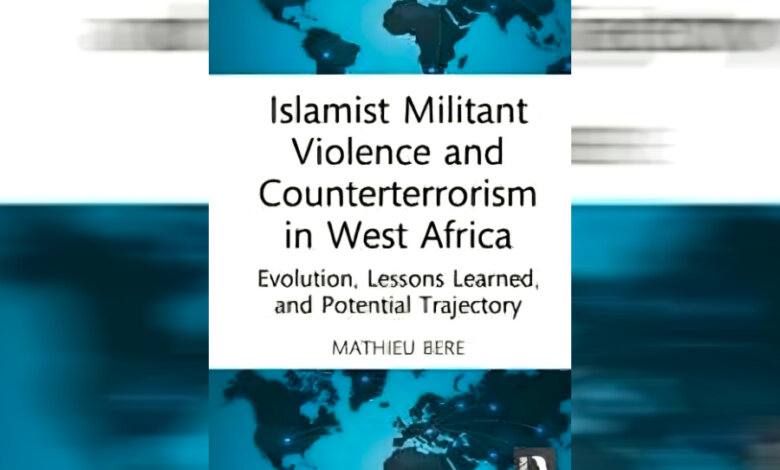
The Sahel has become the world’s most active theatre of terrorist violence, and a new book, “Islamist Militant Violence and Counterterrorism in West Africa: Evolution, Lessons Learned, and Potential Trajectory,” authored by Dr Mathieu Bere, and published by Routledge in 2026, is making the case that the international community’s response to the crisis has been, at best, incomplete, and that without a fundamental shift in strategy, the situation is unlikely to improve.
In his interview with Oral Ofori, the founder of TheAfricanDream.net, Dr Bere explained his data-driven examination of one of the most urgent security challenges of our time. His publication draws on empirical, statistical, and geospatial analyses, as well as field data and multiple datasets, including information from the Armed Conflict Location and Event Data project (ACLED).
Dr Bere traces the evolution of Islamist militancy across Africa from the collapse of the Gaddafi regime in 2011 to the present day, with a sharp focus on West Africa and the Sahel. Three years in the making, the book is interdisciplinary in scope and unflinching in its conclusions.
The Arab Spring, Dr. Bere argues, was a watershed moment. The fall of Gaddafi destabilised the region and triggered a surge of insurgent activity that data has consistently tracked upward in the years since. From 2012 to 2024, fatalities from Islamist violence have climbed steadily in the Sahel and the Lake Chad Basin.
“Based on the number of incidents and fatalities recorded by ACLED, one can say that terrorist violence involving Islamist militants is getting worse in some parts of Africa (e.g., the Sahel and Lake Chad Basin),” said Dr Bere to Mr Ofori.
Northern Africa, home to some of the continent’s most established militant groups, including Al Qaeda in the Islamic Maghreb, has paradoxically seen a progressive decline in both incidents and fatalities in recent years. Southern Africa, with the notable exception of Mozambique’s Cabo Delgado province where an ISIS affiliate remains active, has largely been spared.
The crisis, in other words, is regional and shifting, and it demands region-specific analysis, which is precisely what this book sets out to provide. Before the book’s findings can be fully appreciated, it is worth understanding the significant obstacles Dr Bere faced in producing it. Researching terrorism in Africa is a difficult undertaking, with access to funding and adequate equipment at the top of the list.
Data access is another major hurdle, as not all incidents are reported, and accessing up-to-date datasets from organisations such as ACLED comes at a cost, with strict restrictions on how the data can be used. Most critically, for the safety of both researchers and research participants, it is effectively impossible to conduct fieldwork in many of the areas most affected by terrorist violence.
“For security reasons, for both researchers and research participants, it is almost impossible to conduct research in some of the areas affected by terrorism,” explained Dr Bere to Mr Ofori, emphasising the seriousness of this particular hurdle.
One of the book’s most timely contributions is its assessment of counterterrorism efforts in the Sahel following the withdrawal of French, American, and UN forces from Mali, Burkina Faso, and Niger, a withdrawal precipitated by the breakdown of trust between Western partners and the military regimes that came to power through coups in all three countries.
When France and other Western governments condemned the overthrow of democratically elected civilian governments and imposed sanctions, the military regimes responded with nationalist, anti-imperialist rhetoric to consolidate domestic support, before turning to Russia and other partners willing to engage without political conditions. The result was the unravelling of a decade of defence and security cooperation at precisely the moment it was most needed.
According to Dr Bere, data recorded after the departure of American forces from Niger shows a measurable increase in both incidents and fatalities. He concluded that counterterrorism yields better results when there is trust and strong cooperation between nations.
Rebuilding that trust, Dr. Bere argues, is not optional; it is essential. African governments must unite, repair broken relationships, and fully cooperate with both traditional and new partners if violent extremism is to be meaningfully addressed.
The book does not shy away from the geopolitical dimensions of the crisis. As Western influence in the Sahel diminished, Russia, China, and Turkey have moved in, a shift that has been read by some analysts and policymakers as a direct threat to French and broader Western interests in the region.
Dr Bere addresses the thorny question of external actors and natural resource exploitation candidly. He mentions that accusations that some foreign partners are seeking to control mineral wealth in the Sahel are not without basis. The competition for Africa’s critical minerals predates independence and has never truly stopped.
Both during colonisation and in the decades following formal independence, external actors have competed to control the continent’s resources. His call is not for finger-pointing but for refocus, that African governments and their partners must prioritise the defeat of violent extremism first, and then find mutually beneficial frameworks for managing natural resources sustainably.
“Instead of wasting time and energy accusing and fighting each other, Africans should unite beyond religious and ethnic differences to address the challenge if they want to achieve sustainable results”, emphasised Dr Bere.
Based on a rigorous statistical analysis of available data, Dr Bere concludes that military operations, while sometimes necessary to protect civilians, have produced limited and mixed results overall. He concluded that military force alone cannot resolve this crisis.
The book suggests complementary strategies, including conflict transformation, technology, and civilian-led prevention initiatives, that address the deeper conditions in which violent extremism takes root. This is where the book distinguishes itself from purely academic treatments of the subject.
Beyond its empirical and policy dimensions, the book also offers a theoretical framework designed to help make sense of the irrational violence perpetrated by so-called jihadist groups across West Africa. Why do terrorists emerge and attack in one place and not another? This is a question that cannot be answered without geospatial analysis.
Dr. Bere is modest about the book’s reach, but its relevance is unmistakably broad. For policymakers, military officials, and counterterrorism practitioners, it offers concrete recommendations grounded in lessons learned from both successful and failed initiatives across the continent.
For investors, business leaders, and travellers operating in regions affected by Islamist militancy, it provides a clear-eyed guide to where violence is occurring, where it is likely to spread, and how to anticipate it.
For the general reader, the book explains that the security of the African continent is not a distant concern but a challenge that touches everyone, given that terrorist violence rarely discriminates in its victims.
“If anyone is concerned about peace and security in Africa, or wants to know how Islamist militant groups have been evolving across the continent along the years, then, they should read this book” said Dr Bere to Mr Ofori.
Written by Abeeb Lekan Sodiq