TheAfricanDream.net was on the ground at the United Nations as history was made
The United Nations General Assembly, in a historic move, declared the transatlantic trafficking of enslaved Africans, along with the system of racialised chattel slavery, as “the gravest crime against humanity.” The resolution was led by Ghana with strong support from the African Union.
Adopted on 25 March 2026, the move secured the backing of 123 Member States, signalling broad international consensus. Argentina, Israel, and the United States voted against the measure, while 52 countries chose to abstain.
Beyond the numbers, the vote represented a shift in how the global community is choosing to address the legacy of slavery. Ghana’s role reflected a calculated effort to reframe global conversations around slavery, pushing them toward questions of accountability and reparative justice rather than remembrance alone.
The West African country has emerged as a key voice in a growing international push for justice, building on its broader efforts to become a centre for historical reckoning and dialogue, seen in initiatives like the “Year of Return” and its sustained advocacy within the UN system.
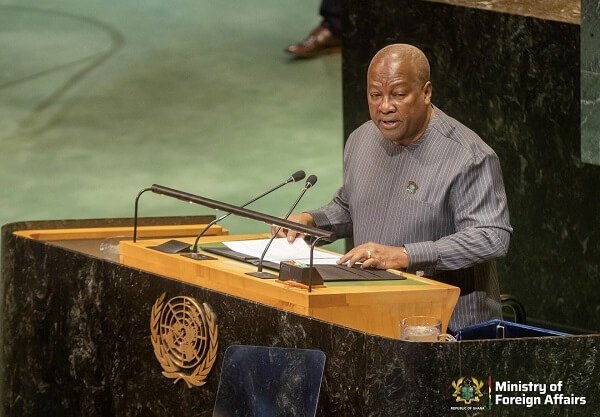
Ghana’s President, H.E. John Dramani Mahama, addressed the Assembly ahead of the vote, framing the resolution in terms of both memory and obligation. “Let it be recorded that when history beckoned, we did what was right for the memory of the millions who suffered the indignity of the slave trade and those who continue to suffer racial discrimination. The adoption of this resolution serves as a safeguard against forgetting. It also challenges the enduring scars of slavery,” he said.
The scale of what the resolution addresses is staggering. Between 1500 and 1800, somewhere between twelve and fifteen million people were enslaved from their homes across the African continent and transported across the Atlantic under conditions of extreme brutality. More than two million did not survive the crossing.
Those who did were forced into generations of unpaid, violent labour that built much of the wealth now concentrated in the Western world. The resolution acknowledges that this history did not end with abolition because its consequences persist today in the form of deep racial inequality and economic underdevelopment that continues to shape the lives of Africans and people of African descent across the globe.
In a post-event interview with Dr. Gnaka Lagoke of Lincoln University in Pennsylvania, the point of Ghana and various groups working together towards this higher level was acknowledged. The 2001 Durban Declaration in South Africa had already recognized slavery as a crime against humanity and highlighted the need for reparations for Africans according to Dr. Lagoke.
“Subsequently, the African Union entrusted Ghana with the leadership of this reparations initiative. This effort began with the ‘Year of Return,’ launched in 2019 by former Ghanaian President Nana Akufo-Addo, who went on to organize a major conference on reparations in November 2023. That conference marked a turning point in the campaign for reparations, fostering a united front for the cause between CARICOM and the African Union,” said Dr. Lagoke. It is also worth noting that the theme for the year 2025—as adopted by the African Union—focused specifically on reparations.
Furthermore, the African Union designated the period from 2025 to 2034 as the Decade for Reparatory Justice. In his capacity as Chair of the Scientific Committee for the 9th Pan-African Congress—held in Togo in December 2025—Dr. Lagoke ensured that the narrative of reparations was integrated into the official documents and proceedings of the Congress. He also ensured that the pre-Congress gathering for the Diaspora—held in Salvador de Bahia in late August 2024 as a prelude to the 9th Pan-African Congress—”was dedicated to the subject of reparations” he revealed to TheAfricanDream.net in our conversation with him.
Reparations, as envisioned by the resolution, are not simply of financial transfers alone; it also calls for a formal recognition of the full horror of what was perpetrated, for genuine historical accountability that begins to address the inequalities that slavery created, which have not been adequately dismantled.
No specific monetary figure is mentioned, and the resolution instead establishes the moral and political framework within which those conversations must now take place. However, not every nation was moved by that framework.
The United States, in explaining its opposing vote, argued through its UN ambassador that it does not recognise a legal right to reparations for acts that were not prohibited under international law at the time they occurred.
Responding to this, Samuel Okudzeto Ablakwa, Ghana’s Foreign Minister said, “We are demanding compensation – and let us be clear, African leaders are not asking for money for themselves. We want justice for the victims and causes to be supported, educational and endowment funds, skills training funds.”
The United Kingdom, a central actor in the transatlantic slave trade, acknowledged the suffering caused but abstained nonetheless, consistent with its longstanding position that contemporary institutions cannot bear legal responsibility for the actions of their historical predecessors. These positions drew sharp reactions from many of those present at the UN that day.
Pan-African news platform, TheAfricanDream.net, was present at UN Headquarters to cover the vote firsthand, moving through the building and speaking with attendees as the results came in. One of the interviewees was an 80-year-old man from Africa who has spent more than half a century living in the U.S., and asked not to be named.
“This is global economic warfare, and if African people were serious, we’d boycott all of these countries that abstained. Bad enough we are stuck economically here in America, but then some fly out to these countries on vacations and fake flexing. Sometimes, when people show you they don’t like you, believe it. Don’t necessarily hate them, but protect yourself and your future from being destroyed by them.”
He continued, “If there was ever a time for Africa to wake up and work harder towards growing leadership that understands the need for long-term sacrifices for the benefit of the unborn generation, then that time is now. No great African leader is ever perfect, even Nkrumah had his own skeletons, but imagine what we could achieve if Africans on the continent worked together with Black people and others in the Sixth Region who believe in a United Africa.”
Folake, 34, a literature teacher from Ibadan, in Nigeria, currently on a visiting fellowship at Columbia University, referenced a copy of Abeeb Lekan Sodiq’s debut novel Like Butterflies, that she brought with her to the UN General Assembly. In her words, she surprisingly drew parallels between the novel’s central theme and what was happening at the UN resolution.
“I was literally reading about Sisi, an enslaved princess in the novel who was reduced to property, and then I walked into the UN and watched the world vote on whether what happened to her and her people should be accounted for. That novel is set in the Oyo Empire in the 1800s, but sitting here today, it feels like it was written for this exact moment, and I couldn’t be more disappointed with the countries that voted against the resolution to make slavery the gravest crime in human history,” she said.
TheAfricanDream.net also spoke with Amara, 26, who arrived in New York from Senegal less than a year ago and is currently studying urban planning. She had come to observe the proceedings and left visibly moved:
“I came to America with my eyes wide open and my hopes even wider. When I heard that 123 countries stood up and said what was done to us was the gravest crime against humanity, I felt something shift inside me that I cannot fully explain. This is the ground being prepared for our future. I am young, I am African, and I have not stopped being hopeful. The world is beginning to tell the truth, and truth is always where justice has to start.”
Denise, 47, a school counsellor from Atlanta, had watched the vote with a growing sense of urgency that he said had been building for months.
“What’s changing that now isn’t this resolution alone, as important as it is. It’s what’s happening in this country right now, under this administration. When your own government walks into the United Nations and votes against a resolution saying that the enslavement of your ancestors was a crime, something inside you breaks, and then something else gets very clear,” he said.
The resolution carries no legal enforceability, but what it represents is the recorded moral position of the international community. More than two-thirds of the world’s nations looked at the history of the transatlantic slave trade and agreed, formally and on the record, that it was the worst thing humanity has done to itself.
Written by Oral Ofori

Oral Ofori is Founder and Publisher at www.TheAfricanDream.net, a digital storyteller and producer, and also an information and research consultant.