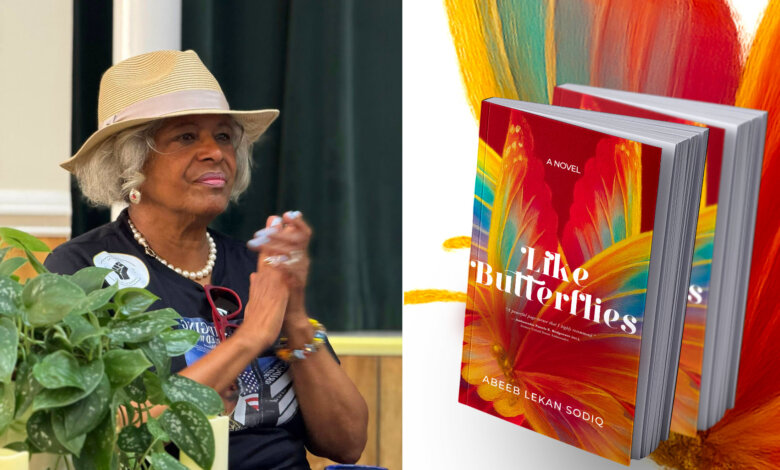
File Photo: Ambassador Pamela E. Bridgewater (left) in a picture with the novel Like Butterflies by Abeeb Lekan Sodiq (right)
The novel, Like Butterflies, a debut historical fiction by Nigerian author Abeeb Lekan Sodiq, enters the growing field of Afrocentric stories that deliberately refuse to simplify one of history’s most painful chapters. Set in the 19th-century Oyo Empire, in western Nigeria, the novel explores slavery as an experience shaped by power and survival.
Scheduled for launch in Black History Month, it has drawn early attention following a review by Ambassador Pamela E. Bridgewater (ret.), former United States Ambassador to the Republic of Benin, the Republic of Ghana, Jamaica, and the first African-American woman to serve as Consul General in apartheid South Africa.
Having read the full manuscript, Ambassador Bridgewater described the book as “a fast-paced journey through the brutal realities of the 19th-century Oyo Empire slave era and the triumph of the human spirit’s determination to be free,” adding that its vivid storytelling makes it “a powerful page-turner.”
The ambassador’s review is relevant because her career has involved long-term engagement with Africa and the African diaspora, including diplomatic service in African and Caribbean nations, and her experience as Consul General in apartheid South Africa.
Working within racially stratified and unequal systems has given her direct insight into how power, segregation, and historical injustice shape societies and individual lives. That background allows her to recognise when a story about freedom is treating those structures with seriousness.
Her response reflects the novel’s themes, which put Like Butterflies within a broader conversation about history, power, and rebellion in the face of oppression.
The book uses the image of a butterfly on its cover as a powerful symbol of freedom, while its colorful appearance reflects the idea that freedom is beautiful and deeply desired. Just as butterflies emerge into the open, the characters long to break free from bondage and reclaim their humanity. They are driven not only to seek freedom, but to fight for it.
The story unfolded in the “sprawling estates of Oyo Empire,” where enslaved people were known only as “parcels,” a term Abeeb uses instead of the word “slave”. At the center of the story was Sisi, an abducted princess sold into slavery, and reduced to another property in her master’s ledger.
As Sisi was exposed to the dehumanization of her time, she came to understand that endurance alone offered no real escape. The story took an interesting twist after she realized that her master’s son had an interest in her, using the romantic relationship as a leverage to motivate other parcels like her into a rebellion. The move tested their limits of fear, loyalty and hope.
The book mentioned how conceiving a rebellion as a parcel was almost unheard of because of the strict punishment, such as the death penalty that usually followed, mostly for the revolutionists. But Sisi was ready to give it all in the fight for freedom, even at the detriment of her own life.
Significantly, the novel began and ended in Africa, shifting from the familiar trajectory of slave narratives that resolve in the diaspora. By doing so, it insists that the story of slavery cannot be fully understood without examining how it reshaped African societies internally.
At its core, Like Butterflies is a meditation on freedom and self-determination free from external coercion or neocolonialism. The novel explores how systems of power subjugated ordinary people and distorted social structures. It shows how an African society was fractured by these systems imposed upon them, giving birth to a local slave system that thrived.
This suggested that a few local actors in power under foreign influence benefited from the sale of their own people. Sisi’s father, who was a king, amassed wealth through this means until his beloved daughter was abducted and sold as a parcel.
With Sisi finding herself in the midst of this cruel and exploitative structure, she resorted to the familiar “African solutions to African problems” approach, leading a rebellion against those in power, locally, and calling for a change to upend local actors acting on behalf of or benefiting from the established foreign slave system.
At 217 pages, the first-edition novel is tightly structured, favoring emotional and moral tension. The book marks the fiction debut of Abeeb, who is also the Managing Editor of TheAfricanDream.net. He has written or edited over 1000 articles on pan-African stories, culture, and contemporary affairs, a background that shows the novel’s editorial discipline and thematic focus.
Written for African readers, the African diaspora, and the global literary market, Like Butterflies puts African history within a universal conversation about power, survival, and the enduring human desire for freedom.
While Ambassador Bridgewater’s review lends international visibility to the novel, Like Butterflies ultimately stands on its own as a work that invites reflection rather than provocation. The novel arrives as a confident debut that looks inward as well as outward.
The book was printed in Nigeria by Pupa Studios, with consulting support from TheAfricanDream LLC. It will be launched in Ikeja 1 Local Government Area, Lagos, Nigeria, on February 26, at a landmark initiative, “Project 1000: The Future is Here,” in partnership with ICT CDS Executives of Ikeja 1 LGA (NYSC Lagos).
Written by Oral Ofori

Oral Ofori is Founder and Publisher at www.TheAfricanDream.net, a digital storyteller and producer, and also an information and research consultant.