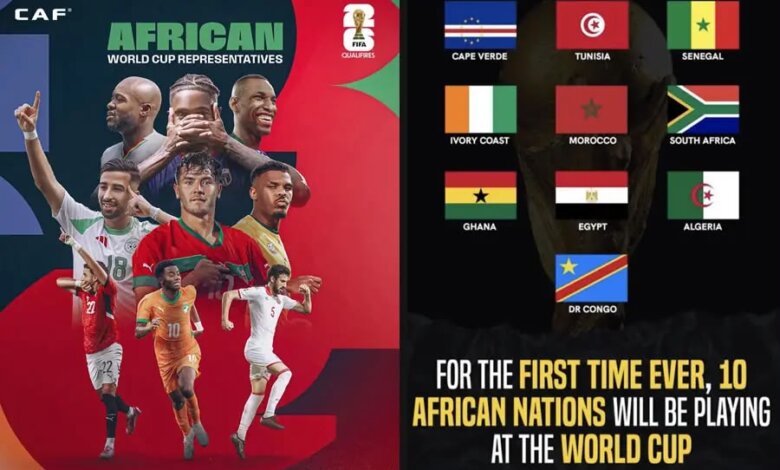
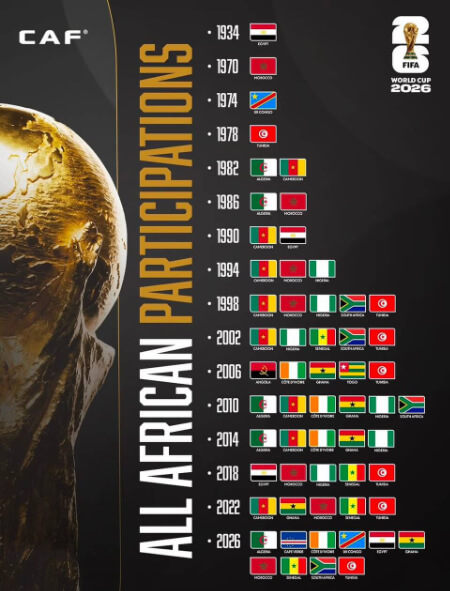
Africa made history at the 2026 FIFA World Cup with a record 10 teams flying the continent’s flag on football’s biggest stage. Morocco, Senegal, Egypt, Ghana, Algeria, Tunisia, Côte d’Ivoire, Cape Verde, South Africa, and DR Congo all booked their places, marking the strongest African presence ever at a single World Cup.
Not only is this a numeric milestone, it signifies progress and a rising global influence. Each team carries a unique story, a passionate fanbase, and the hopes of an entire continent. Here are some fascinating facts about each of the teams making Africa proud in 2026.
MOROCCO
Morocco enters the tournament as Africa’s biggest modern World Cup success story. In 2022, the Atlas Lions became the first African and Arab nation ever to reach a World Cup semifinal, defeating Belgium, Spain and Portugal along the way.
The team boasts of stars such as Achraf Hakimi and Hakim Ziyech. Many of Morocco’s players were born in Europe but chose to represent their ancestral homeland, creating one of the strongest diasporic squads in world football.
Morocco was also the first African nation to top a World Cup group back in 1986. Four decades later, they are now viewed as genuine contenders rather than underdogs.
SENEGAL
Senegal’s football story is one of Africa’s most inspiring. The Lions of Teranga stunned the world in 2002 when they defeated defending champions France in their very first World Cup match and reached the quarterfinals.
Led by stars such as Sadio Mané, Senegal won their first Africa Cup of Nations title in 2022 and have remained one of the continent’s most consistent teams.
The nickname “Lions of Teranga” comes from the Senegalese concept of hospitality and generosity. Yet on the pitch, they are known for their physicality, pace and tactical discipline.
EGYPT
Egypt is Africa’s most successful football nation at the continental level, having won a record seven Africa Cup of Nations titles. The Pharaohs are captained by global superstar Mohamed Salah, one of the greatest African players of all time.
Despite Egypt’s rich football history, World Cup success has been surprisingly elusive. Their most famous appearance came in 1990, when they earned a memorable draw against the Netherlands.
Ancient Egypt gave the team its nickname, “The Pharaohs,” making it one of the most recognizable identities in international football.
GHANA
Ghana owns one of the most dramatic stories in World Cup history. In 2010, the Black Stars came within a penalty kick of becoming the first African team to reach the semifinals.
The famous quarterfinal against Uruguay remains one of football’s most talked-about matches. The Black Stars have also produced legendary players such as Abedi Pele, Asamoah Gyan and Michael Essien.
Ghana’s youth teams have been equally successful, winning multiple FIFA youth championships and producing generations of elite talent. This will be Ghana’s fifth World Cup appearance.
ALGERIA
Algeria’s national team is known as “The Desert Foxes,” a nod to the resilient foxes that inhabit the Sahara.
Their most famous World Cup appearance came in 1982 when they shocked West Germany 2-1. The result was so unexpected that it contributed to FIFA changing the scheduling of final group matches.
Algeria’s 2014 team pushed eventual champions Germany to extra time in one of the most exciting matches of that tournament. Many observers still regard that squad as one of Africa’s strongest ever.
TUNISIA
Tunisia is one of Africa’s most experienced World Cup participants. The Carthage Eagles became the first African team ever to win a World Cup match when they defeated Mexico in 1978. The team takes its nickname from the ancient civilization of Carthage, one of the Mediterranean world’s great powers.
Tunisia is known for disciplined defending and tactical organization. They may not always attract headlines, but they consistently qualify for major tournaments and are among Africa’s most reliable football nations.
COTE DÍVOIRE
The Elephants have produced some of Africa’s greatest footballers, including Didier Drogba and Yaya Touré.
Côte d’Ivoire’s golden generation reached three consecutive World Cups between 2006 and 2014. Although they often found themselves in extremely difficult groups, they gained worldwide respect for their exciting style.
The nation arrives at the World Cup as one of Africa’s strongest sides after recent continental success and a new generation of talented players.
CAPE VERDE
Cape Verde is the ultimate underdog story of the 2026 World Cup. With a population of roughly half a million people, the island nation becomes one of the smallest countries ever to qualify for a World Cup. This is their first appearance on football’s biggest stage.
Nicknamed the Blue Sharks, Cape Verde has steadily risen through African football thanks to smart scouting, strong organization and talented players from its global diaspora.
Their qualification is widely regarded as one of the greatest achievements in African football history.
SOUTH AFRICA
South Africa made history by hosting the 2010 World Cup, becoming the first African nation ever to do so.
Known as Bafana Bafana, meaning “The Boys,” the team played a major role in uniting the country after apartheid. Football has long been intertwined with South Africa’s social and political history.
This qualification marks a return to the global stage and gives South Africans hope of recreating the magic that surrounded the 2010 tournament.
DEMOCRATIC REPUBLIC OF CONGO
DR Congo has one of the most fascinating World Cup stories. The country first appeared at the tournament in 1974 under the name Zaire, becoming the first team from sub-Saharan Africa to qualify for a World Cup.
Their return in 2026 ends a wait of more than 50 years. DR Congo secured the final African spot through the intercontinental playoffs, completing Africa’s historic group of 10 representatives.
Nicknamed the Leopards, they combine physical strength, flair and a deep talent pool drawn from both domestic football and the Congolese diaspora in Europe.
FUN FACT: Between Morocco’s semifinal run, Ghana’s 2010 heartbreak, Senegal’s 2002 giant-killing exploits, and Cape Verde’s fairy-tale debut, Africa may have its strongest World Cup contingent ever and many analysts believe multiple African teams could reach the knockout rounds in 2026.
Written by Oral Ofori for TheAfricanDream®