South Korea press conference slams religious minorities pressure
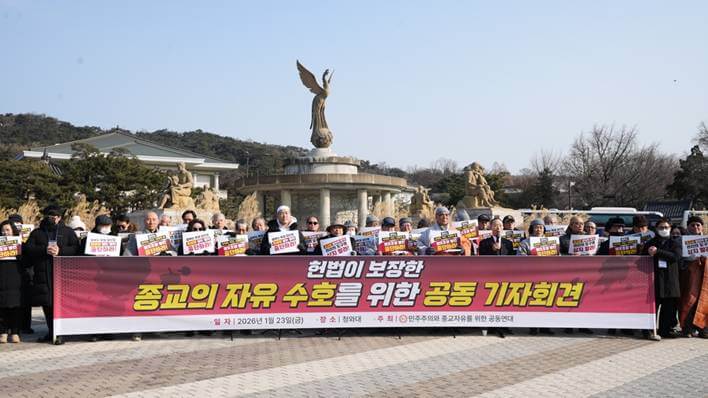
Photo: Members of the Alliance for Democracy and Religious Freedom gather outside Cheong Wa Dae, the presidential office in Seoul, for a press conference addressing recent government statements and investigative directives / © SCJ TV
The Alliance for Democracy and Religious Freedom convened an emergency press conference outside Cheong Wa Dae, the presidential office in central Seoul, South Korea, formally announcing its establishment on January 23.
The coalition includes civic and religious organizations from across South Korea and approximately 100 participants, including Buddhist, Christian, and Muslim leaders, legal professionals, university professors, and civil society advocates.
Convened under the banner, “Joint Press Conference to Defend Constitutional Religious Freedom,” the gathering responded to statements made during a January 12 luncheon between President Lee Jae-myung and leaders of seven major religious denominations.
At that meeting, President Lee through spokesperson Kang Yu-jeong characterized specific religious organizations, including Shincheonji, as a “social menace,” vowing that the government would eradicate them.
Within a single day of these remarks, the prime minister ordered a sweeping cross-ministerial investigation, swiftly mobilizing the state apparatus to target specific religious groups, a development the coalition deemed deeply troubling. The press conference was called to voice grave concerns over what organizers described as an escalating campaign of state-sponsored persecution.
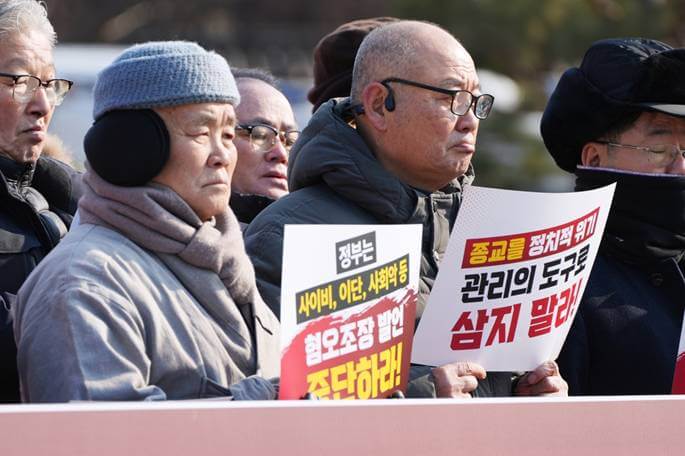
The coalition’s co-chairs contend that the government has long tolerated established religious leaders cultivating political relationships and wielding influence over voting constituencies.
They argue that allegations of church–state collusion are aimed chiefly at minority religious groups, with investigations disproportionately focused on these communities rather than mainstream denominations. They characterized this as textbook “selective justice.”
Christian and Buddhist leaders warned that treating religious minorities as pariahs while deferring to established denominations could establish a dangerous precedent threatening religious liberty for all.
Venerable Beopsan, Buddhist co-chair and president of the General Headquarters of the Daegak Order of Korean Buddhism, stated, “What we must safeguard now is not the interests of any single denomination, but the foundational principles that enable diverse faiths to coexist namely, the Constitution and human rights.” He added, “Protecting my neighbor’s freedom today is what ensures my dignity tomorrow.”
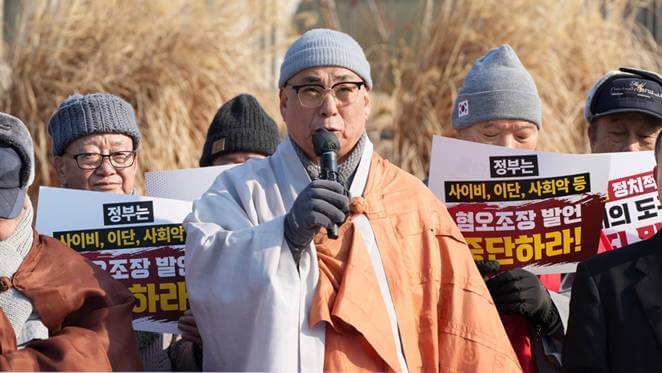
He further cautioned that branding groups as “evil,” often consequently results in egregious human rights violations, emphasizing, “We must hold firm in our resolve not to repeat that tragic history.”
Imam Kim Won-taek, representing the Muslim community, said he attended the press conference to defend freedom of conscience and the rights of all minority faiths. Citing Qur’an 2:256, he emphasized that faith “cannot be defined or excluded by state power,” underscoring that religious belief must remain free from coercion.
He added that, “the state is not an arbiter filtering citizens’ beliefs” but rather, “must serve as a guardian ensuring different faiths can coexist without fear.”
He called on the government to fulfil its obligation to protect religious freedom, invoking international human rights instruments including the United Nations Charter, the Universal Declaration of Human Rights, and the International Covenant on Civil and Political Rights (ICCPR).
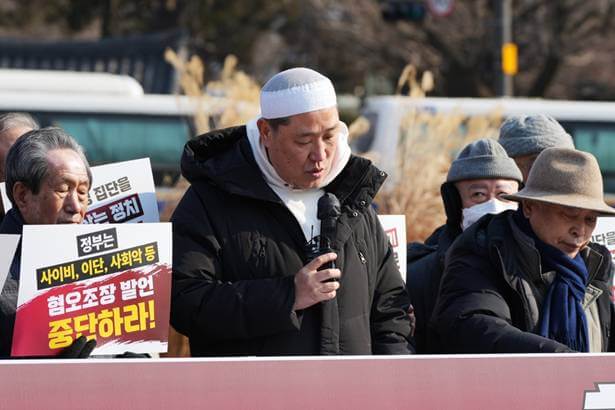
He argued that religion-related matters should be adjudicated fairly based not on doctrine or religious identity, but on specific unlawful acts and demonstrable harm.
The coalition’s co-chairs characterized the situation not as a narrow domestic religious dispute, but as evidence of democratic erosion in South Korea. They asserted that government rhetoric—lacking clear legal foundation—about “disbanding” religious organizations or seizing assets constitutes a direct assault on constitutionally protected property rights and freedom of association.
They particularly criticized Prime Minister Kim Min-seok for designating certain religions as “a social evil that must be eradicated” during a January 13 cabinet meeting and ordering a joint police prosecution investigation along with a whole-of-government response, arguing that such actions betrayed fundamental human rights principles, namely, that the state has no authority to stigmatize citizens’ beliefs as a “social evil.”
Invoking Article 20 of the South Korean Constitution, which guarantees freedom of religion and mandates separation of church and state, the coalition warned that government rhetoric centered on “eradication” not only undermines the rule of law, but also risks inciting extreme hostility and deepening national polarization.
The coalition’s co-chairs urged the Lee Jae-myung administration to take the following actions:
- The South Korean government must immediately cease all actions infringing upon religious freedom through abuse of state power.
- The president and prime minister must issue public apologies for discriminatory statements that disregard constitutional principles, and pledge to prevent their recurrence.
- The coalition called upon the United Nations and other international bodies, as well as organizations worldwide dedicated to freedom of religion or belief, democracy, and human rights, to conduct firsthand verification and issue formal statements expressing grave concern and recommendations regarding anti-democratic religious discrimination and repression in South Korea.
The coalition stated it intends to stand in solidarity with global civil society and pursue coordinated advocacy aimed at advancing democracy both in South Korea and internationally.
Source: SCJ TV

Oral Ofori is Founder and Publisher at www.TheAfricanDream.net, a digital storyteller and producer, and also an information and research consultant.